
65% of Elderly Falls Happen at Home. What If You Could Predict a Fall Before It Happens?
- Doshi Vigneshwar
- Feb 27
- 8 min read


A few weeks ago, I wrote about a phone call that changed everything for me — Rajesh, calling from Singapore at 2:17 AM, his voice trembling, four thousand kilometers away from his fallen mother.
That post was about why the future of home care for the elderly in Chennai had to be both intelligent and human.
This one is about what we actually built to make that future real.
The Number That Kept Me Awake
India has over 153 million people aged 60 and above. By 2050, that number will cross 347 million — nearly the entire current population of the United States.
And yet, nearly 71% of India's elderly live in non-metro or semi-urban areas with limited access to quality senior citizen care. Even in a city like Chennai, with its world-class hospitals and medical infrastructure, the gap between "emergency care" and "daily dignified care" is enormous.
Here's the harder statistic: over 65% of falls in elderly individuals happen at home, often in the bathroom, often at night, often when no one is watching.
And the cruelest part? In most cases, the fall wasn't sudden. The body had been signaling distress for days.
We just weren't listening early enough.
That realization — that most caregiving reacts when it should anticipate — became the founding philosophy of everything we built next.

The Moment I Knew We Needed More Than Caregivers
It was a Tuesday evening. I was reviewing our care logs for the week when I noticed something that stopped me cold.
Three separate incidents. Three different homes across Chennai — one in Adyar, one in Anna Nagar, and one in Velachery. Three elderly individuals who had experienced a fall, a health scare, or an anxiety episode. And in all three cases, the family found out after the event. Sometimes hours later.
Our caregivers were doing everything right. They were trained, empathetic, and present. But they couldn't be everywhere at once. No human can be.
I sat with that thought for a long time.
What if the home itself could be a caregiver? Not replacing the person with the warm hands and the patient voice — but watching when they can't, listening when no one is there, and raising their hand before a problem becomes a crisis.
That's when we started building what we now call our AI-Enabled Care and Tech Ecosystem.
What "AI-Enabled" Actually Means in an Indian Home
I want to be specific here, because "AI-enabled" has become one of those phrases that means everything and nothing.
When we say it, we mean four very concrete things — four systems that now form the backbone of how we deliver elder care at home across Chennai and beyond.
1. CareCam: The Caregiver That Never Sleeps
CareCam is an AI-powered visual monitoring system that we install discreetly in key areas of the home. It doesn't stream video to families — and this was a deliberate design choice that we fought hard for internally. No parent wants their child watching them eat lunch on a video feed. That's surveillance, not care.
Instead, CareCam uses computer vision to learn routines. What time does an elder typically wake up? How long do they usually spend in the kitchen? What does "normal movement" look like for them specifically?
Then, when something deviates — unusual stillness, a fall, a period of inactivity that falls outside her pattern — the system sends an alert. Not a video clip. A message. "Amma hasn't moved from the living room in 90 minutes. This is unusual."
The guardian or the care provider gets this on WhatsApp. They can call immediately, or they can check the status update, or one of our caregivers can be dispatched for a welfare visit.
The result: a 40–60% reduction in reactive caregiver dependency, according to our early data. Families stop calling out of panic. They start calling out of connection.
2. The Udaya Alert: Making Safety a Morning Ritual
Here's something most people don't talk about in the context of elderly care in India: the specific anxiety of the morning check-in.
Every adult child who has an aging parent living alone in Chennai — or anywhere in India — knows this feeling. You wake up. You wonder. Did Amma sleep okay? Did Appa get up? Should I call? What if I'm disturbing them? What if I don't call and something's wrong?
This low-grade daily anxiety is not small. It wears families down. It strains relationships. It makes the caregiver feel guilty for living their life.
We built the Automated Reassurance Check — internally we call it the Udaya Alert, from the Tamil and Sanskrit word for sunrise — specifically to solve this.
It's elegantly simple. Every morning, the system detects the first signs of activity from the senior — movement picked up by CareCam, or a connected smart mat, or a fitness band — and automatically sends a warm message to the family: "Amma is up and beginning her day ☀️"
Not a clinical report. Not vital signs. Just the reassurance that the person they love is alive, up, and starting their morning.
We've seen this single feature reduce morning anxiety calls by over 60% among families whose parents have enrolled. And for the seniors? They feel less monitored and more celebrated.
Every morning, someone knows they're awake. Someone cares.
It converts monitoring into a daily ritual of connection.
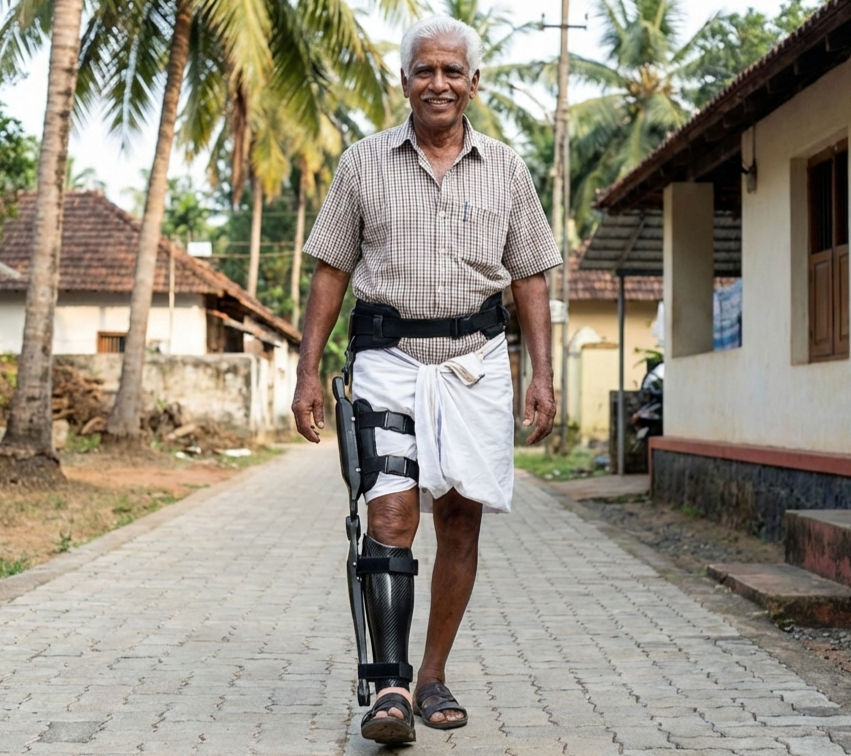
3. Intelligent Assistive Gadgets: Proactive, Not Reactive
Here's a pattern I noticed across dozens of families we work with in Chennai:
The assistive gadgets — the raised toilet seat, the grab bar, the fall-detection watch, the orthopedic mattress, the ergonomic walking cane — almost always arrived after the incident that made them necessary.
A fall. A back injury. A near-miss. We decided to flip this entirely.
Our Intelligent Assistive Gadgets program is not a product catalogue. It's a proactive recommendation engine built on top of our care data. As our caregivers observe the seniors' mobility, balance, sleep quality, and daily patterns, the system identifies which assistive devices would genuinely improve safety and independence before something goes wrong.
A senior in Nungambakkam who has been getting up more slowly from chairs? Our caregiver flags it, the system recommends a riser recliner, and we arrange a trial before she even realizes she might need it.
An elderly gentleman in Thiruvanmiyur whose gait has subtly shifted? We recommend a smart cane with a fall-detection sensor before his family has to face the fear of a hospital visit.
The gadgets are integrated with caregiving, not sold separately. They're not upsells — they're prescriptions. And in a city like Chennai, where 65% of homes were built before modern accessibility standards, making homes safer is not a luxury. It's a necessity.
4. The Companions Marketplace: Care at Your Fingertips
There's a specific kind of frustration I hear constantly from families in Chennai seeking elder care services.
"My father needs a physiotherapist who can come home twice a week. But the good ones aren't available on weekends. And I don't know who to trust."
"Amma needs South Indian meals, no salt, no oil — delivered at lunchtime. Every day. I've tried three services, and none of them are consistent."
"We need someone for four hours on Sundays when our regular caregiver is off. But we don't want a stranger from an agency we haven't vetted."
The common thread? Trust. India's care economy is fragmented, unorganized, and severely under-standardized.
The Companions Marketplace is our answer. It brings together verified healthcare providers, home nursing care services, elder care specialists, therapists, meal delivery services, and activity planners — all under one platform, all curated specifically for Indian families and Indian elders.
Think of it as not a generalist marketplace, but a care marketplace — built exclusively for health and care verticals, with a verification and review layer that gives families the confidence to make decisions quickly.
For families in Chennai, this means access to in-home physiotherapy, yoga for seniors, meal delivery with specific dietary requirements, respite care, and even curated senior-friendly travel — all from the same app, with the same trust layer.
For service providers across Tamil Nadu and beyond, it means a platform that sends them clients whose care needs are already understood.
The data flywheel is the magic here: as we understand each senior's needs better through CareCam and daily care interactions, the marketplace becomes smarter about what to recommend. Not ads. Genuine care suggestions, data-driven.

What This Ecosystem Actually Feels Like
I want to paint a picture.
Kavitha's mother, Mrs. Saraswathi, lives in T. Nagar. Kavitha lives in Toronto. She used to start every morning in a knot of worry, wondering if the seven-and-a-half-hour time difference meant she'd missed something terrible overnight.
Today, her morning looks like this.
She wakes up. By the time she's made her coffee, there's a WhatsApp notification. Amma is up and beginning her day ☀️. She smiles. She doesn't call — her mother hates being disturbed before she's had her morning coffee, too.
At noon, their Companions caregiver, Priya, arrives. Priya already knows from the morning's activity report that Mrs. Saraswathi had a restless night and moved around less than usual. She asks gently about her sleep. She adjusts the afternoon — a slower walk, more sitting, some music. She flags it for the care coordinator. The system notes the pattern.
In the evening, Kavitha gets a brief update — not an alarm, just a note that her mother had a quieter day and that Priya adjusted accordingly. She calls at 7 PM Chennai time, and her mother answers on the first ring, in a good mood.
No panic. No guilt. Just care.
That is what the ecosystem is supposed to feel like.
The Bigger Picture: Why This Matters for India
India's elder care industry is currently valued at approximately ₹7,500 crore and is projected to reach ₹1.5 lakh crore by 2030. The demand is not coming — it's already here.
But the supply side is broken. Most families in Chennai, Bangalore, Delhi, and Mumbai are navigating a completely fragmented, trust-deficient care market, cobbling together solutions from multiple sources, hoping each part works.
What we're building at Companions is the operating system for Indian elder care — a unified ecosystem where human care, AI intelligence, assistive technology, and a trusted marketplace work together seamlessly.
And we're starting in Chennai, because Chennai is not just a market. It's a mirror for the rest of urban India. The multigenerational families, the NRI children, the aging population in established neighborhoods like Adyar, Besant Nagar, Kilpauk, and Mylapore — they represent the mainstream of what India will look like in a decade.
If we can solve it here, we can scale it everywhere.

What I Want You to Take Away
If you are reading this in Chennai, trying to figure out home care for your aging parents — this is what I want you to know:
You don't have to choose between technology and humanity. The best elder care at home is both.
You don't have to live in constant low-grade anxiety. There are systems now that can watch without intruding, warn without panicking, and connect without controlling.
And you don't have to navigate this alone. That's exactly what we built Companions to solve.
The ecosystem is alive. The caregivers are trained. The technology is deployed. And every day, we're learning more from the families who've trusted us — in T. Nagar and Mylapore, in Anna Nagar and Neelangarai, in homes across Chennai and beyond.
We started this company because we believe that growing old in your own home, surrounded by familiar walls and familiar faces, with dignity and safety intact, is not a luxury.
It is a right.
And we intend to make sure every Indian family can access it.
If you want to explore how Companions' AI-enabled elder care ecosystem can support your family, visit us at www.companions.in or reach out on WhatsApp at +91-91500-95220.
Explore our services: Elder Care Services Chennai | AI-Enabled Elder Care | Home Care for Elderly | Elderly Caregiver Chennai | Senior Citizen Care | Home Nursing Care Chennai | Caretaker for Senior Citizens at Home | Fall Detection for Elderly | Elderly Care at Home Chennai | Companion Care for Seniors | AI CareCam Elder Safety | Senior Care Marketplace India | NRI Elder Care Services India

Comments